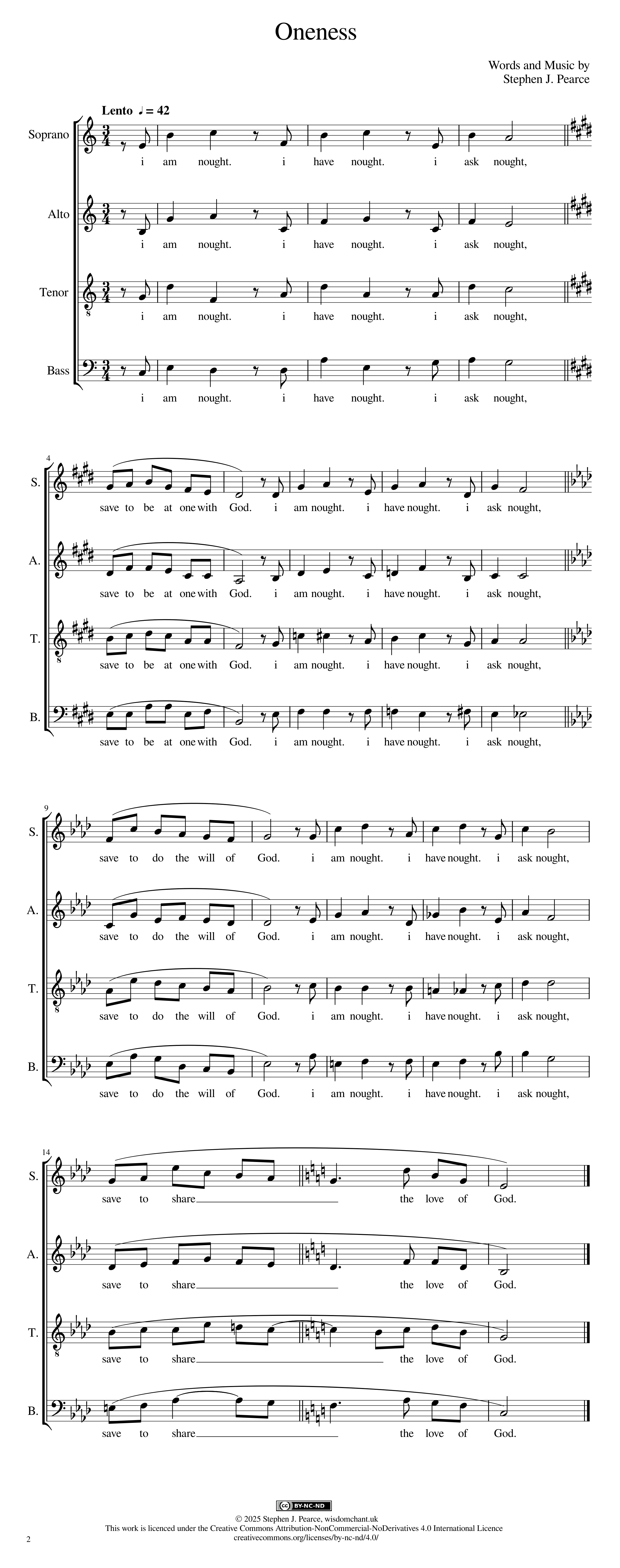
i am nought.
i have nought.
i ask nought,
save to be at one with God.
i am nought.
i have nought.
i ask nought,
save to do the will of God.
i am nought.
i have nought.
i ask nought,
save to share the love of God.
Listen
We proceed in hope that eventually the spiritual journey will bring us to the point where we can say with St. Paul, I live now not with my own life but with the life of Christ who lives in me.
(Galatians 2 v 20). Thomas Keating’s favoured term for this state of being is ‘Oneness’.
The evolution of this chant began with the words, I am nothing; I have nothing; I desire nothing
, an ancient saying referred to by Fr. Thomas in Part 2 of the video series ‘That We May Be One’. Although I was drawn to this as a lyric it seemed a bit harsh and I tinkered with ideas to soften it by qualifying what the singer might desire. At some point in this process I came across a comment in an interview with a WCCM Oblate from the Northeast of England; when asked how he saw his busy life in social work as being compatible with his contemplative vocation he replied, T’ love of God is nowt till you share it!
I decided immediately that that had to go in. What then emerged was the Trinitarian lyric structure that you see here.
I sat with this for a long time absorbing the full implications of its meaning before a melody crystallised out of it. Then, when I came to add the lyric to the score I recoiled in horror at having to begin typing with a capital ‘I’. This just seemed to undermine the whole idea. Fortunately, very soon after that experience I noticed the following statement in Invitation to Love: The “I” of self-centredness diminishes to a very small “i”.
That is why I adopted the rather unconventional typography that I have.